
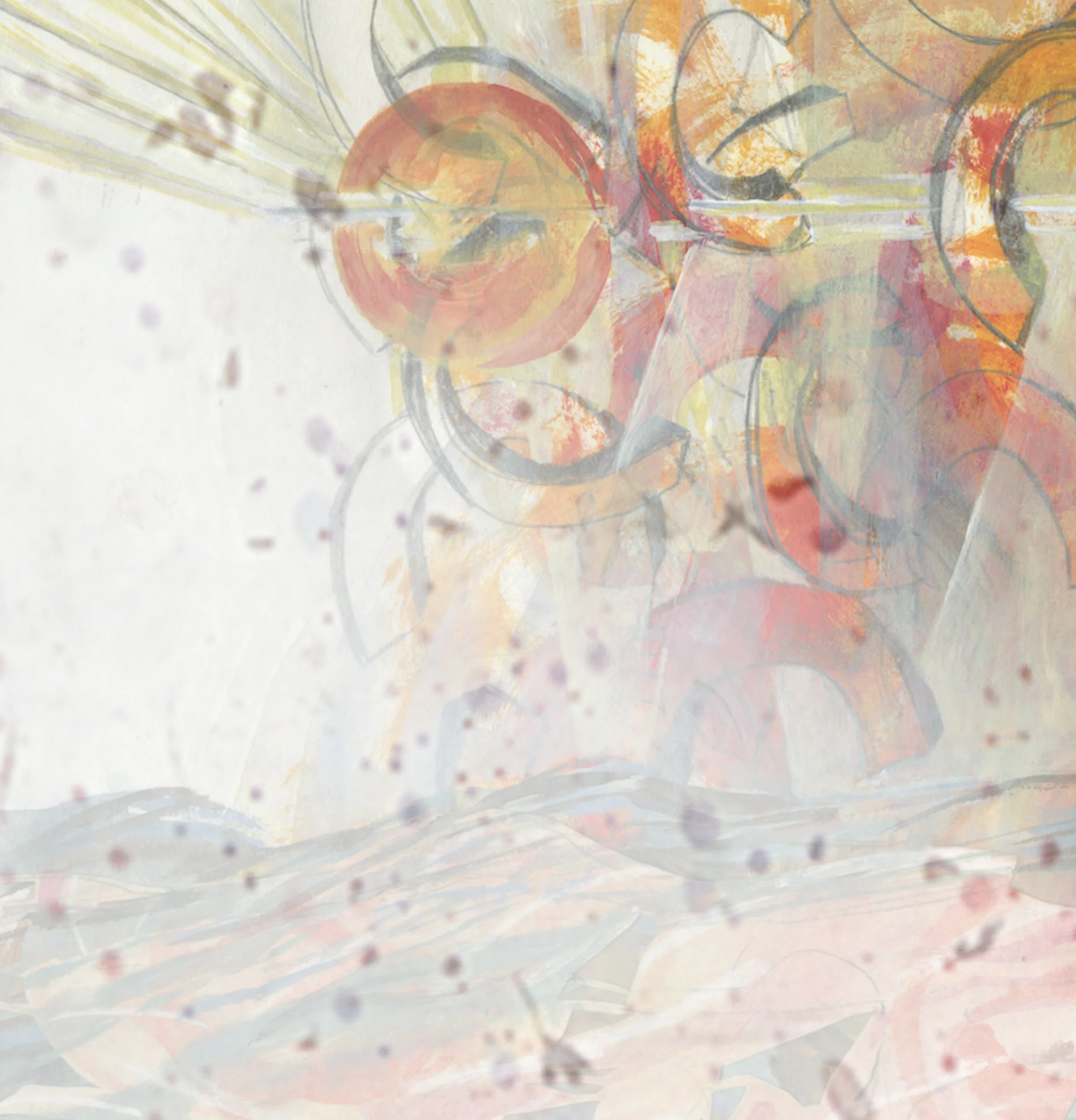
Intermission: is a co-hosted four-course dinner evening, a framework for connection that works like musical chairs where everyone gets a seat. The evening is for relaxing, nourishment, and leaving feeling better than when you arrived.
The structure creates conditions where unfamiliarity and shared vulnerability become common ground. Bold colors fill the room.
People meet people they wouldn't have met otherwise and connect more deeply with those they already know.
Co-hosting is logistics, yes, and it is also co-authorship. The planning, the people you invite, your energy and presence, and the questions you bring — all of it shapes what the evening becomes.
What co-hosting is and isn't
What you bring shapes what the evening becomes — your people, your presence, your energy. And you're not doing it alone. We're building the evening together. The framework already holds the structure (the timing, the flow, the questions, the design), so you're not starting from scratch.
Part of the vision is that co-hosting is enjoyable. The parts you take on should feel good — and the structure is designed so it's not a second job.
The foundation: Invite the determined number of guests from your life. Manage RSVPs together (we have a spreadsheet!). Show up. Be present.
If you want to go deeper: Collaborate on the menu, the seating chart, the questions, the mutual aid initiative. Some or all — whatever calls to you.
The timeline is real. Once we begin, there's an RSVP deadline, a date, a guest count we're working toward. That structure is part of what makes the evening work.
The time we spend planning together is part of the project — the exchange begins there, not just at the dinner. This invitation to you is because I want to build this evening with you. I hope you receive it with joy! If you're not sure whether this is the right moment for you, tell me before we begin. A no is not a problem. An external yes that is an internal maybe that becomes a no is harder. If you're in — I look forward to what we create and what unfolds together.
Cuisine
Food is taken care of. The pressure of what to bring/make is relieved. Guests can center on showing up.
Past cuisines have included cooking for the bulk of the day (i.e. risotto) to catering (tamales from a woman in Bushwick).
Re: $$ I am not expecting you to pay for food.
Some inspo:
Rirkrit Tiravanija: cooking as relational art, hospitality as method.
Alison Knowles ("Make a Salad"): food preparation as performance, nourishment as art.
Co-host action: Help with menu? dietary restrictions from your guests?
Vibe
Bold color brings energy into the space.
Attire is bold monochromatic: colors only, no grayscale, no black, no white.
From my experience, "what should I wear?" is one of the most common questions when someone gets invited to a seated dinner. "Whatever you want" can be paralyzing. Over time, Intermission: developed "bold colors" as a clear constraint where you know exactly what to reach for. Feedback has been that it's fun, it's a relief, it gives permission to wear something you've been waiting for an occasion for.
The whole evening is designed: table settings, decor, lights, projections. The guests' clothing is part of that composition.
Some inspo:
Faber Birren (Color Psychology and Color Therapy): saturated color increases energy and stimulation.
Josef Albers (Interaction of Color): how colors behave in relationship to each other.
Luis Barragán: bold saturated color as environment, not decoration.
Co-host action: Remind your guests about the dress code closer to the date.
Timing
5:30-5:45pm: Arrival window (drinks out and available)
6:00-8:00pm: Four 30-minute courses
Invitation says 8:30pm: This is a buffer so if a guest has a second plan in their evening they don't plan to leave before this time in case we go over the course timing.
Co-host action: Arrive at a time determined together for set up..
Flow
Guests move for every course (barring an accessibility need). The seating chart is pre-determined.
Each guest has a stack of colored tent cards at their starting seat — one card for each course. The top card shows their current table and seat. When a course ends, guests move their top card to the bottom of the stack. The next card is a different color with a table number and seat # for their next course.
For example: everyone starts with a green card. When it's time to switch, they move the green card to the bottom. Now they have a red card with a table number and seat #.
Some inspo:
World Café (Juanita Brown and David Isaacs) — rotation between tables to break up fixed groupings.
Augusto Boal's Theatre of the Oppressed — no fixed positions. The spectator becomes actor. Everyone participates.
Co-host action: We can make a time to work together to design the seating chart.
Questions
Crystal bowls with hand-written questions sit at each table as optional entry points of dialogue.
The goal for how the questions are designed is to lower the threshold for conversation — to give people somewhere to start. The questions are structured around contemplative and reflective practice and designed around these conditions:
Must have (every question):
No absolutes — no "best" or "favorite" or language that causes force ranking.
Draw on personal experiences — the answer comes from their own life, not general knowledge.
Offer a way to answer lightly — someone can choose to go deeper, but the question must be answerable without going deep.
Everyone has an answer — assume nothing about someone's life. Not everyone has a mom, a partner, a childhood home, a job they love. The question won't assume an experience they may not have had.
Not hypothetical — "What would you do if..." is not framing for this exercise. Openers like "What is a time you..." work well.
Can have (but not required):
Memory-based (past) or forward-looking (future) — both work.
Ask for a moment, a time, a place — these tend to ground people in something concrete.
Sensory — something you could picture or feel. These often spark richer answers.
Concrete, not abstract — "a time you saw ripples of water" is easier to answer than "a time you felt peaceful."
The ultimate goal is people actually talking to each other — not small talk, not debate. David Bohm calls this dialogue as collective thinking.
Examples:
"What is a small moment in your regular routine that you love?"
"What is a time you saw ripples of water?"
"What is one of the most peaceful places you have ever been?"
Some inspo:
Mary Oliver: "Attention is the beginning of devotion."
Paulo Freire: Everyone holds knowledge. Everyone has experience worth sharing. No hierarchy of answers.
David Bohm: Dialogue as collective thinking, where assumptions are suspended and people think together rather than debate.
Co-host action: If you'd like to contribute questions for this Intermission:, you're invited to.
Mutual Aid
Guests are invited to contribute to mutual aid as part of the evening, connecting the abundance of the table to needs beyond the room. This is an invitation, not a requirement.
Some inspo:
Peter Kropotkin (Mutual Aid: A Factor of Evolution): cooperation, not just competition, as a factor in survival.
Dean Spade (Mutual Aid: Building Solidarity During This Crisis and the Next): collective care as political action.
adrienne maree brown (Emergent Strategy): interdependence, moving at the speed of trust.
Co-host action: If you have an initiative you'd like to be considered for this Intermission:, please share it with me! The two I’ve been focusing on are @gazamutualaidsolidarity and @safepassageproject
Everyone leaves charged, nourished, connected, & ready for what the next days hold. That's the evening.
That's what we're doing together.
More about Intermission:
Intermission: began in Juneau, Alaska as a personal project for femme-identifying individuals, a structure for connection, a way to create conditions for genuine exchange. The first one was centering on International Women's Day, rolling out of winter, spring equinox energy.
Juneau is a small place, no roads in or out, surrounded by water and mountains, so one imagines all people having their supports by knowing everyone and connecting with ease. People close enough to support one another, but somehow never crossing paths, not realizing their proximity to someone they'd want to know.
In 2013 I was in my eighth year of living in Juneau and navigating a difficult period within my life. It became a grounding exercise for me to observe the women in my community for inspiration, their strengths, their persistence, how they moved through things. I'd ask these same women "oh do you know so and so?" and so often, to my surprise, they didn't. I began imagining an aerial view of these badass women, at arm's length of one another, not knowing the support right next to them. In my own life at this time, these women were giving to me without ever framing it that way. None of them ever asked for anything in return. I often wished I could somehow return the support. Then I realized this was something I could do and I could put them in a room together. Time can be carved out. Support can go around. Connection is right there, just untapped.
The first Intermission: was curated specifically with women I knew who I wanted to know one another. When working on the invitations I was so inspired by their yeses, everyone ready to meet and be present with others, and was steeped in reading Paulo Freire at the time, his "learner among learners" as a path to liberation. These two inspirations led me somewhere I didn't expect within the planning of this first round, inviting another woman I didn't know well myself but wanted to know. This way unfamiliarity and shared vulnerability became common ground for everyone at the table.
When I've felt called to do Intermission: again, May 1st is where I land. International Workers' Day, which is also my birthday. My birthday is a time I feel my own abundance. What does my gratitude for another year even mean when the world is what it is? Sometimes I feel frenetic about needing to do more. What is more? What is it to add to the world? There are a lot of answers to this question. For me, in conjunction with spring and birthday and rebirth and energy, I am practicing the slowness part of it. Being in the room with people, sharing food, talking to someone you wouldn't have met otherwise.
I think about Audre Lorde calling caring for ourselves an act of political warfare, self-preservation not self-indulgence. I think about Rebecca Solnit writing about hope as an axe you break down doors with. I think about connection and gathering as a necessary labor within the resistance cycle.
As I continue to age I am grateful for learning of all the work people are doing to better the world. Guests are invited to contribute to mutual aid as part of the evening, connecting the abundance of the table to needs beyond the room.
The project has expanded in other ways too. It started with femme-identifying individuals as a connective identity, rooted in my own need for women supporting women. As I have proceeded to host another and another, I have zoomed out to think about the framework that is Intermission:. The structure works with people who are willing to show up and be present with others. The framework is malleable. The second Intermission: I ever held, I asked a person I wanted to know better to co-curate the room. This way the evening opens before the dinner begins. The exchange begins there, in the process of planning together. I love this expansion on so many levels. Just like the first Intermission: where I too didn't know everyone at the table, it's a gift to me too to get to attend. What they bring, who they invite, changes what the evening becomes.
That first Intermission: in Juneau stays with me. Time can be carved out. Support can go around. Connection is right there, just untapped. Being in the room together is enough of an act to be deemed important within the cycle of things. Every time I've held Intermission: I am thanked, but it's selfish of me to have it. It's as much for me as anyone else attending. Just like Octavia Butler says, "All that you touch, you Change. All that you Change, Changes you."